Tuesday, October 11, 2011

Truth & Reality

Philip K. Dick’s The Man in the High Castle is an exploration of the purpose and power of fiction. Fiction offers us an alternate reality where we can explore new possibilities and open our minds to more than one perspective that we would otherwise not consider. It is far easier to escape into a fictional world, than to face reality. Thus, the poignancy of the book lies not in the stories, but in Dick’s use of fiction as a means of enlightening us and broadening our horizons—broadening our sense of reality and forcing us to question it.

The first alternate reality takes place fourteen years after World War II, where the Axis Powers are victorious. The Grasshopper Lies Heavy, the book-within-a-book, postulates yet another alternate reality, where the Axis Powers lose World War II to the Allies but with a different sequence of events. By showing that every character in the book is living a false reality, Dick brings forth the frightening concept that perhaps there does not exist a central “true” reality. Perhaps there are only several juxtaposed layers of alternate realities and we just happen to be living in one of them.

Another important point Dick makes is through the I-Ching, which symbolizes how reality is subjective and swayed by perspective. Regardless of what results the I-Ching produces, the terms we are left with (like “pleasure” and “clarity”) are so vague that they are ultimately left to our own personal interpretation. Consequently, there is no concrete answer or reality beyond our inner truth.

If we want to take this concept even further, since truth is based on perspective, we could say that truth could be everywhere. And if truth is everywhere, truth is also nowhere. And so we find ourselves back at square one asking ourselves what is truth? What is reality? Is there such a thing?

Perhaps if you know you are insane then you are note insane. Or are you becoming sane, finally. Waking up. I supposed only a few are aware of all this. Isolated persons here and there. But the broad masses…what do they think? […] Do they imagine that they live in a sane world? Or do they guess, glimpse, the truth…? (41)

"Tone Is Everything"

When I first began reading The Man In The High Castle I couldn’t help but become frustrated with the short staccato way in which Mr. Tagomi talked. The sentences are succinct and terse, and do not flow. There are no emotions or added detail. I feel as if I am reading a brief report which gives only the facts, not reading a novel or listening to a dialogue. Now, however, I am realizing that the tone with which each character talks is intentional and important. There is a clear difference between the Juliana’s dialogue and Mr. Tagomi’s. Also, within Mr. Tagomi’s sections, there is a difference between the narrator’s sentences and the sentences which ‘originate’ in Mr. Tagomi’s mind.

Dick warns through one of his characters, “Tone is everything” (240), and now I’m beginning to understand why. In this example, tone is important because it declares place in a society that values this above all else. The tone with which a man talks, including the conciseness with which he says it, portrays his influence and standing among those around him. For me, though, it portrays something different. The lack of emotion portrays a sense of urgency and a world where people simply “go through the motions”. Tagomi’s thoughts are expressed without emotion or opinion. There is no inclusion of superfluous thought. This reminds me of the use of the I Ching. The I Ching removes responsibility from the user. The amount of value the characters place in the I Ching prevent them from having to take responsibility for their actions since they believe the I Ching holds all of the power. If a person has no control or responsibility over his own life, how can he truly live it? Instead, I believe that this person simply goes through the motions while never actually experiencing it.

I view this in stark contrast to Juliana’s life, whose dialogue contains emotions and details. Her thoughts are expressed completely and flow together in a more natural way than those of Mr. Tagomi. She also takes responsibility for her actions and does not consult the I Ching as often as other characters. Her actions are more powerful than those of the other characters and she is portrayed as a very strong and independent woman. Although she adores having Joe around, she overcomes him in both a physical and mental battle when her ‘moment of truth’ comes. At this moment she develops a more complete understanding of the world in which she has been living and learns her role in it.

Monday, October 10, 2011

Symbolism

A major focus in The Man in the High Castle is on the significance of material objects, in particular, the value of real and fake goods. Three instances in the book highlight this topic particularly well. Wyndham-Matson, a collector, possesses two relatively similar zippo lighters, one that was in FDR’s pocket at the time of his assassination and one that is artificial. Even though the lighters look quite similar, Matson places a much higher value in FDR’s lighter as opposed to the artificial lighter, because FDR’s lighter contains “historicity”. Likewise, Childan, a merchant of old American goods, is mortified when he realizes he is selling potentially fraudulent guns. The perceived history behind the lighters and the guns is what determines their value, yet this history is impossible to prove, rendering the value to be arbitrary. The closest verification we can achieve is a certificate of authenticity, but even that can be forged. We also read about the supposed “wu” (inner-truth) of the pins that Frank and Ed are creating. The experience of this wu is left up entirely to interpretation; people can experience wu differently, some may not experience it at all. The underlying theme of these three examples is that, in this book, the value of material objects is determined by the intangible significance people arbitrarily place in them.

This application of value to an object based on interpretation reminds me of how we analyze books. We extract certain lines from a book and add our personal interpretation to them, in order to give them meaning. The basic point of symbolism is to read an object or event as representing something greater than its presence at face value. However, most of the symbolism we find in books can have different interpretations, depending on who is reading the book.

We discussed in class that The Man in the High Castle is a metaphor for reading a book. I think Dick constructed a piece of this metaphor by writing about people literally using symbolism, by attaching value to material goods based on their interpretation of the significance of those goods, similar to the way readers assign value to certain words, images and objects in books. However, Dick constructed a world where people cannot distinguish between the authentic and the artificial and result in placing value arbitrarily based on only what they think is true. This phenomenon sends me, as a reader, the message to not even try to determine the “truth” in a book, because it is impossible to determine. I should instead value the parts of the book that mean something to me, while realizing that my interpretation is purely personal and may not hold much value to a different reader.

Sunday, October 9, 2011

Anchor Points

Where I come from, astrology is big deal and this is established the moment you are born. Once you are out of your mother’s womb, an astrologer prepares a paper marking the cosmic coordinates of your birth and this paper stays with you all your life. This paper is a pretty important marker of a person’s identity. It is also somewhat like the I Ching in the sense that people consult astrologers regarding whether a certain life decision would be favorable according to their birth papers. In fact, it’s common practice to get birth papers “matched” in order to decide whether two people should get married. I know that at least in my house, this paper is guarded better than my birth certificate. Sabrina pointed out in class how it is ironic that the birth certificate is such a flimsy paper. Well, this paper is even flimsier. It is handmade. It gets rolled up like an ancient scroll and is wrapped over with a piece of red cloth. I have never taken actually one good look at my birth certificate, but I would be devastated if I were to lose this roll of paper, or if I were to find out that it’s not “authentic.”


What we consider the “anchor points” of our identity, I guess, largely depends on our cultural backgrounds, our history. This becomes relevant in the scope of an alternate world too. In the book The Man in the High Castle, Childan considers the artifacts in his shop to be a mark of his heritage. In a world where his culture had been invaded and was prone to die out, the genuine Americana became his anchor point. If he were in the current world, it is unlikely that would happen. In the alternate world of the book, it is common for people to change names or even their faces. In the current world, our names and our faces would be considered pretty valid anchor points to us.


It just goes on to show how our identities are interlaced with our culture. After all, what is in a name? Why does the authenticity of FDR’s lighter matter? Why do I connect my identity to a roll of paper that has a lot of archaic words that I don’t understand and a bunch of numbers scribbled on a Sudoku-like grid work? Except in the light of culture and history, our idea of identity almost seems arbitrary.

What does authenticity mean?

Throughout Man in the High Castle we see the struggle of authenticity and really begin to wonder what it actually means. Or better yet, why it matters. For an item to be authentic it has to be the real deal, that the facts are straight. But what if there is an emotional attachment to an item it can be just as authentic, even if it does not have a piece of paper with it that supposedly verifies it.

When I was little, I was sick a lot and my brother wanted to go to the dollar store really bad and I could not stay home alone. So, he convinced me to go by telling me to take my prized possession, Mr. Bear (my naming creativity when I was younger to this day amazes me), along for the trip because he would make me feel better. When I got home, he was missing. We thought I left Mr. Bear in the car, we soon found out that I actually left him in the store. My mother dutifully drove back, only to find out that the woman who owned the store sold him.

That year for Christmas Mr. Bear was under the tree. I was three or four at the time, so it was some real Christmas magic. I thought Santa had brought Mr. Bear back to me and, unsurprisingly, was absolutely delighted. The magic was lost when I realized the truth about Santa, but only for a moment. Maybe this was not the same Mr. Bear that I had lost all those years ago, but he had been there longer, so the authenticity did not phase me. I loved the bear, still do, and he is Mr. Bear, there is no identity crisis there. So he’s not the authentic Mr. Bear, but he became the authentic one with the emotional attachment.

One can understand why authenticity matters, however. It is much like the truth in story telling we discussed in The Things They Carried. We do not like to be lied to, if a story is told like it is true, it better be true. But what is considered true depends on the person, and I think likewise authenticity has to take emotional attachment into account and varies person to person.


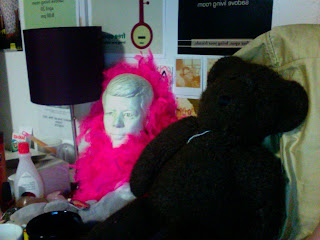
Yep, Mr. Bear is at college now, chilling with a bust of JFK.

Can you feel the historicity?

In The Man in the High Castle, Wyndham-Matson claims that out of his two almost identical lighters, one was in the pocket of President Roosevelt when he was assassinated and one wasn’t. One has “historicity” and one is a copy. However it is almost impossible to tell the difference between the two, although President Roosevelt’s lighter is worth thousands of times more than the fake. All that he has to differentiate between the two is a certificate of authenticity. He asks his guest if she can feel the historicity of the historical lighter, and of course she cannot. But I think historicity could be a valid concept, depending on the significance of an object to a person; however it is less of a feeling and more of a memory connected to an object.

As we talked about this in class I began to consider myself whether “historicity” is important to me. Honestly, I think it is. If I were to order a signed poster from my favorite singer, I would want it to be authentic. It would have no meaning to me if the singer hadn’t signed it herself. It would not have any “historicity.” I know that you cannot technically feel the historicity of an object, but if I knew something was authentic I would feel more connected to the actual person (in this case). For this very reason I would never order a signed poster on the computer. I would want to get a signature in person so I myself could know for sure that the signature was authentic. Not only that, but by getting it signed in person I would have a memory to connect myself with the signature. The signed poster would have more meaning to me than one I could buy online even if I knew 100% that the one on the computer was authentic.

Now if I had this poster, it might not mean much to most people, however I do think some of the historicity could be transferred to another fan of the singer. If I told my story to that person about how I got it signed and what it was like meeting the singer, they would also feel connected to the signature on the poster. They might be also able to feel its “historicity.” However if that person told their friends the story of how I got the poster signed, and those friends told their friends (I know this is an unlikely situation, but just roll with it), there would be a growing disconnect between each of these new groups of people and their knowledge of my poster and in turn, some “historicity” would be lost. It is my guess that it would mean far less to the 100th person who hears of my poster signing adventure than the 2nd person because they would have learned from a friend who was not there to witness the actual event.

I can see how it would be almost impossible to truly feel the “historicity” of a historical object, unless you were actually a witness of the event. If Wyndham-Matson had actually been a witness to the assassination of President Roosevelt, he might not have been kidding about being able to feel the “historicity” of the lighter. The lighter would in that case be a trigger for a memory and it would have significance that a replica would not have. However if I held that lighter (if I was in the world depicted in The Man in the High Castle of course), I would not be able to connect the lighter with my own memory and I probably wouldn’t know why it was more important than the replica. But if Wyndham-Matson had told me a firsthand account of Roosevelt’s assassination and how he had come to acquire the actual lighter (assuming that it was the real lighter and that he was trust worthy), I might have felt differently about the lighter. The “historicity” would be there.

On Thursday we talked about authentic in class and then some mention the fact that both the actual book we are reading is not authentic because it focuses on an alternate universe. Also the book inside the book, the grass Hopper lies heavy, is another unauthentic universe on how the world would be if the allies how one. In reality the allies did win but the book inside the book doesn’t depict the actual facts.


The grass Hopper lies heavy is based on two things one being that FDR wasn’t assassinated and two that Italy had to betray the Axis, but then again if they had won they would have been the allies. I can somewhat see why in that book it would take Italy to win the war, because of the out come of World War

I.(I was unaware of the assassination attempts on FDR)


Then again the author was on freaking acid, while he wrote this (or maybe he wrote it on the calm down…) then was he himself authentic. Obviously drugs alter your state of mind, and so how can we know that it was his authentic self the person we can see and acknowledge that wrote the book.


The book also raises the topic of authenticity in the historicity of an object. Most of the collectors are Japanese and the I Ching, which is a Chinese object, plays a huge role in the lives of people. The book doesn’t display the dominance of Japanese culture other than the bowing. In a sense the book makes a mockery of the lack of authentic Japanese cultural presence.

Double Consciousness

After class on Tuesday, I attended my philosophy class contemporary moral issues with Professor Werner. I have referenced him before in my blog posts because so much of what we discuss can be applied to the novels we have read. In class we examine everything from gay marriage, sexism and racism, to capital punishment. This class in particular the term double consciousness arose. I have never heard of it before; alike most moral beliefs we discuss. Double consciousness is most commonly experienced within an individual member of a minority amongst a greater population. This concept states that you know how to behave when you are around another culture, and adjust to their customs, their beliefs, accents, etc. But then goes on to say that while your amongst your own minority, you act naturally and differently than you would amongst a majority group. You don’t only act differently, but you think differently. Whether it is subconscious or you are aware of the way you are acting is debatable. Not only is this sense developed in settings where religion, race, or culture clash but it can be applied to situations such as school. For example, I speak differently to teachers in class then I do to my friends.

Double consciousness is important because I believe that it can be applied to The Man in the High Castle and seen throughout the novel. The difference between cultures seems to be a conflict addressed throughout the book thus far. I think that Robert Childan and Joe have experienced this double consciousness. Childan witnesses it at dinner with the Asian couple of Paul and Betty Kasouras. Although he may not have adjusted to their culture, he was respectful of it and aware that he did not belong from the minute he drove onto the street due to the nice cars, the clean-cut lawns, and the beautiful apartments. The gap between the two cultures was very noticeable as he was a white man amongst and Asian family meal. “He wondered if they too sensed the unbridgeable hap between themselves and him” (Dick, 115). Also, I believe Joe experiences this throughout his relationship with Juliana. It is obvious that he is Italian, but tries his best in public to blend in with society by hiding his accent, dressing the part, and keeping a lot of his stories secret to avoid the cultural barrier it would create. Racial and religious differences are prevalent in The Man in the High Castle, and this creates a moral sense of double consciousness within the characters.